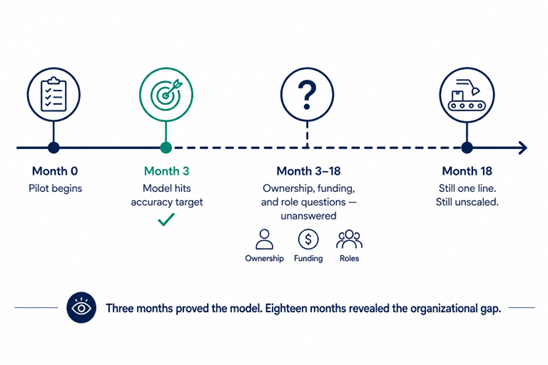
A quality-inspection pilot hit its accuracy target in month three. Eighteen months later, it was still running on a single line. This is a composite pattern we see repeatedly across manufacturing AI rollouts — not one company’s story, but most companies’ story.
A successful pilot is only the beginning.
Picture a mid-sized manufacturer piloting a computer-vision quality-inspection system, catching defects that tired human inspectors were missing late in a shift. Within three months, the model hit its accuracy target. Leadership called it a success and signed off on wider rollout.
A year and a half later, the system was still confined to that one pilot line.
The model continued to perform. The rollout stalled over questions the pilot had never been designed to resolve: which of the other lines gets the system next, whose budget covers the hardware at each site, who owns the model once it stops being a project and starts being part of daily operations, and what happens to the inspector roles it’s already made partly redundant on that first line.
Nobody had assigned an owner to any of those questions before the pilot began. So when it succeeded, the questions arrived all at once, and progress simply stopped.
The decisions that come after the pilot
Most conversations about AI pilots stay focused on the pilot itself — did the model hit its target, did the demo land well, did leadership sign off on phase two. That’s the wrong place to look for where these efforts actually stall.
A pilot is built to answer a narrow, technical question: does this work in a controlled setting? It says nothing about who owns the system operationally, how it gets funded past a single site, which roles change because of it, or who has the authority to sequence a rollout across a dozen locations. Once the pilot succeeds, those questions become unavoidable operational decisions — and ownership is often unclear.
The Deloitte data shows that the problem extends well beyond individual pilots. In Deloitte’s 2026 State of AI in the Enterprise report, 82% of organizations expect at least 10% of jobs to be automated within three years — yet 84% haven’t redesigned a single job around AI. A successful pilot proves technical feasibility. Scaling depends on decisions about ownership, funding, roles, and rollout.
What an unscaled pilot actually costs
A stalled pilot rarely appears as an immediate financial loss. The costs accumulate elsewhere.
Trust Cost is usually the first cost to emerge. Line managers who watched a proven system sit idle for a year don’t forget it — the next AI proposal doesn’t get evaluated on its own merits, it gets filed under “like the last one, probably.” That skepticism is rational. It’s also expensive, because it raises the bar every subsequent initiative has to clear before anyone takes it seriously.
The competitive cost is less visible. Every month of delay gives competitors more time to deploy what you have already proven. Eighteen months between proving a capability and deploying it at scale is eighteen months a better-organized competitor doesn’t have to spend catching up.
The least visible cost is the investment that never gets converted into a deployed capability. That’s the sunk-decision cost. The hardware, the tuning time, the pilot team’s hours — none of that was wasted when the pilot succeeded. It becomes wasted retroactively, the moment the project stalls, because a proven pilot with nowhere to go doesn’t just fail to compound. It becomes the example someone points to when the next budget request gets questioned.
Design the path to scale before the pilot begins
The organizations that scale successfully define ownership, funding, roles, and rollout while the technology is still being tested.
This is the layer Arisanaa works in: not just proving a model can work, but designing the operating model around it from day one, so success has a funded, owned, sequenced path forward already in place. It is less exciting than the pilot itself, but it determines whether the investment becomes part of the operating model or remains a successful experiment.
If you have a pilot sitting in exactly this spot — proven, praised, and stuck — let’s talk about what’s actually stopping it from scaling.