Trade spend is one of the largest controllable expenses on a CPG company’s P&L, trailing only cost of goods sold. Recent industry research puts 59 to 72% of trade promotions at a loss. Most finance teams know this in the abstract. Very few can say, with confidence, which specific promotions in their own calendar are the problem.
A budget everyone approves and nobody can fully explain
Trade promotion spending runs at roughly 20 to 30% of gross sales for many consumer goods companies — an enormous number, second only to cost of goods sold. It gets planned every quarter, defended in every budget review, and rolled forward year after year with remarkably little scrutiny of whether last year’s version actually worked.
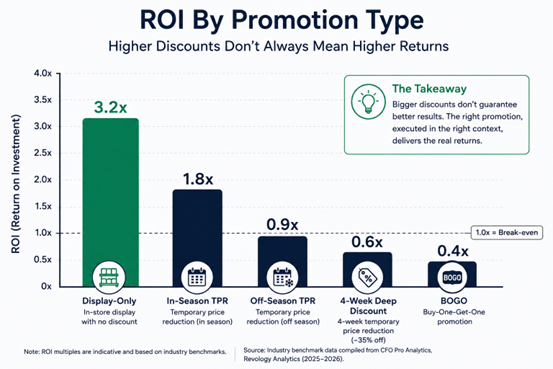
The data on that last point is uncomfortable. Multiple industry analyses converge on a similar figure: somewhere between 59 and 72% of trade promotions are unprofitable once the real cost is accounted for. The reasons are familiar: deep discounts subsidizing loyal customers who would have bought at full price anyway, pantry-loading that borrows next month’s sales instead of creating new demand, cannibalisation across a brand’s own portfolio, and promotional mechanics chosen more from habit than analysis.
A promotion can generate an impressive sales spike and still destroy value. The problem is that many organizations continue to judge promotions primarily on uplift rather than true incrementality and profitability.
Why this keeps happening, year after year
The deeper problem is organizational. Three functions share the same promotional budget but often work with different definitions of success, while post-event measurement gets far less attention than pre-event planning.
Sales, marketing, and finance are optimizing for different things. Sales teams are frequently measured on volume, which makes a promotion — any promotion — the fastest lever available, regardless of what it does to margin. Finance is watching profitability. Marketing is watching brand equity and share. Three functions, three scorecards, one promotional calendar trying to serve all three at once.
Post-event analysis rarely happens with the rigor pre-event planning gets. Promotions get carefully forecast before they run. Far fewer get carefully measured after, because the team has already moved on to planning the next quarter’s calendar by the time last quarter’s results would be worth reviewing. Industry analysis consistently points to post-event measurement and baseline discipline as critical gaps in promotion effectiveness.
The rollover habit compounds the problem. A recognized pattern in the industry — sometimes called “Same As Last Year” — has teams repeating a promotional calendar with only minor adjustments, because building a new one from scratch is slower and riskier than defending a familiar one, even when the familiar one has never been rigorously tested.
The result is a familiar cycle: the calendar gets planned, the promotions run, sales lift gets reported, and the organization moves on before anyone has established which events actually created profitable incremental demand.
What separates the brands actually improving this
The gap between brands that are improving trade spend ROI and brands that aren’t tends to come down to a few specific practices, not a specific software purchase.
Granular measurement, down to the SKU and retailer level. Rigorous promotion analysis starts with a credible baseline and measures true incrementality rather than simply comparing promoted sales with a prior period. At the granular level, companies can see how performance varies by SKU, retailer, promotion mechanic and event — making it possible to identify where trade dollars are genuinely creating value and where they are simply subsidizing existing demand.
Discipline over spend, not more of it. Recent analysis of nearly 9,000 CPG brands found that increasing promotional spending did not automatically improve returns. Among brands that increased spending from 2024 to 2025, only 30% improved their incremental ROI. The strategic big spenders that did improve returns achieved nearly double the improvement in incremental ROI compared with the previous year, despite spending less overall. Strategy, not budget size, was the differentiator.
A shared measurement standard across functions. The brands closing this gap treat post-event analysis as a required step in the promotional cycle, not an optional exercise — with sales, marketing, and finance working from the same profitability definition, rather than each function defending its own version of what “worked” means.
How Arisanaa approaches this
This is where Data & Decision Intelligence becomes useful.
The starting point isn’t a new promotional platform. It is a clean, trustworthy view of what actually happened, promotion by promotion, SKU by SKU, retailer by retailer, measured against a single agreed definition of profitability that sales, marketing, and finance all sign off on together.
Once that foundation exists, the harder organizational question becomes answerable: which promotions in next quarter’s calendar deserve to be rolled forward, and which ones have simply survived because nobody looked closely enough to stop them?
That foundation also determines whether AI and forecasting tools layered on top actually add value or simply produce faster, more confident versions of the same unexamined decisions. A predictive model built on unreliable promotional data doesn’t fix the problem. It automates it.
If your trade promotion calendar has line items nobody’s rigorously reviewed in over a year, that’s usually where the biggest opportunity is hiding.