If you have spent any real time in manufacturing operations, you have probably lived through some version of this situation. An ERP rollout that promised to transform the plant, and instead just moved the same paper-based process onto a screen. Go-live day arrived, the reports looked cleaner, but nothing about how people actually made decisions changed. The problem was nobody redesigned the workflow around the system. They just relocated the old one into it.
AI is at real risk of repeating that mistake, for the same underlying reason.
A recently published IndustryWeek piece made the point well: “A factory is not a spreadsheet.” A generic AI model, however capable, does not arrive already knowing your equipment, your maintenance history, your failure patterns, or the dozens of exceptions your most experienced supervisors have learned to manage over the years. A manufacturer can deploy a genuinely powerful tool and still see only modest results if it’s working from generic assumptions inside an unchanged workflow — the AI equivalent of an ERP system dutifully digitizing a broken process.
We keep hearing versions of this problem at companies that would never describe themselves as “AI enterprises.”
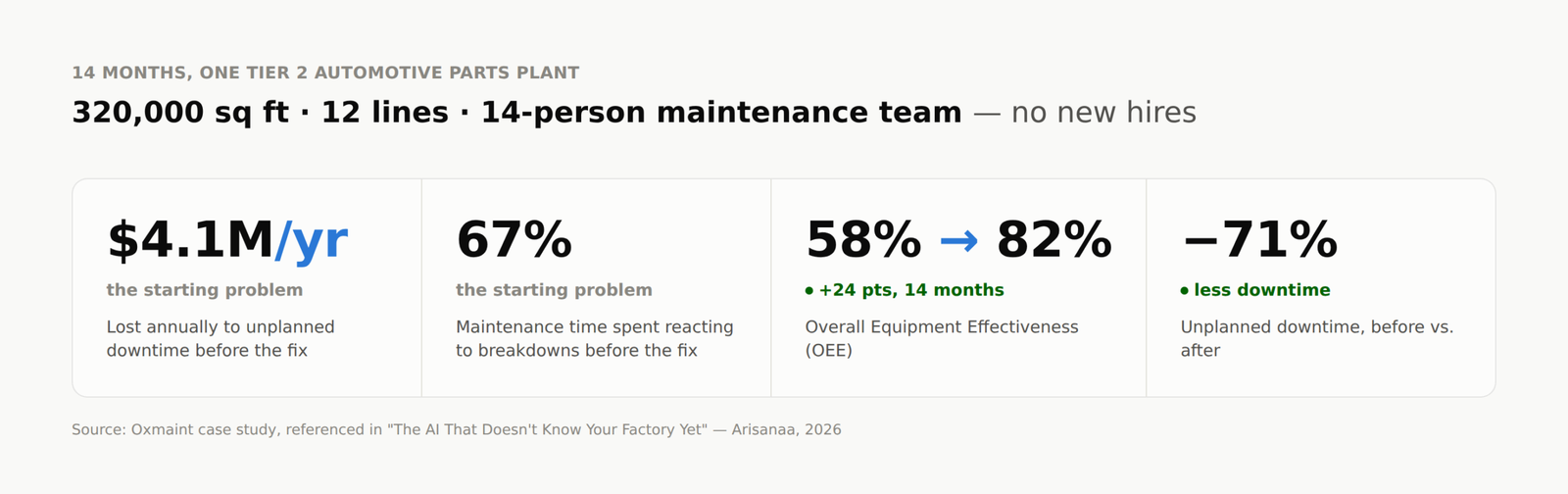
Take a Tier 2 automotive parts plant for example from a published case study we came across — 320,000 square feet, twelve production lines, a maintenance team of fourteen and no dedicated data science function. Nothing about it reads like a typical AI success story. It was losing an estimated $4.1 million a year to unplanned downtime, and reactive repairs were consuming roughly two-thirds of the maintenance team’s time — the familiar trap where everyone is too busy firefighting to understand what is causing the fires in the first place.
The fix was not a large platform purchase. It started with the plant itself — its failure history, its specific assets, its maintenance records, the way its own engineers actually diagnosed problems. The goal was not a model that understood industrial equipment in general. It was one that understood these machines in the factory. Fourteen months later, OEE had moved from 58% to 82%, and unplanned downtime had fallen 71%. The maintenance team hadn’t grown. The same fourteen people were simply acting on predictions instead of reacting to failures, because the tool had finally been shaped around how they worked.
The same plant, before and after — fourteen months, same fourteen-person team.
Call it customize first: the discipline of adapting AI to your specific equipment, data, and decisions before scaling it, rather than scaling a generic tool and hoping your operation adapts to it instead. It is slower at the start. It is also the part competitors can’t simply buy off the same platform you did — by the time they catch up on the technology, you will have spent a year building the data habits and operating knowledge that make it actually useful.
We do not have this fully figured out. AI in manufacturing is still early, and every plant brings its own constraints and challenges. But the pattern keeps turning up in places with no AI budget to speak of, which is usually a good sign it is real rather than aspirational.
Before the next AI pilot, four questions are worth asking first:
- What specific business decision or operational problem are we trying to improve?
- What data from our own factory does the AI need before its recommendations become genuinely useful?
- What operational knowledge currently lives in the heads of experienced engineers and supervisors that the system does not know yet?
- What will people actually do differently when the AI gives them an answer?
None of those questions are about which model to buy. That’s the point. The model is the easy part — customizing it to your factory is where the actual advantage gets built.
Sources & further reading
Kaihan Krippendorff, “How Do We Make AI Understand Our Factory?” IndustryWeek, September 1, 2026. industryweek.com
“Automotive Parts Manufacturer Boosts OEE 58% to 82% with AI Predictive Maintenance,” Oxmaint case study, March 21, 2026. oxmaint.com